Excess ground humidity within coastal South Carolina foundation vents directly influences sub-floor structural integrity. According to moisture guidelines from the U.S. Department of Energy , unsealed vented…
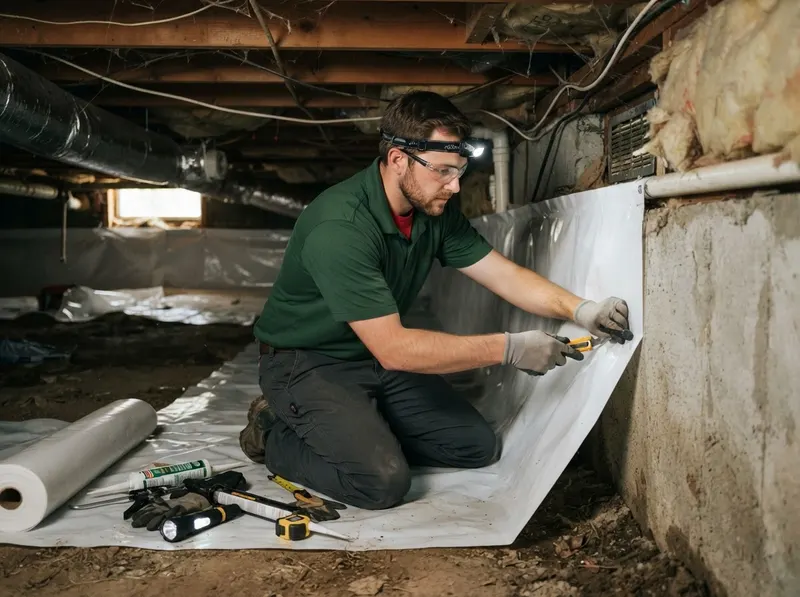
Excess ground humidity within coastal South Carolina foundation vents directly influences sub-floor structural integrity. According to moisture guidelines from the U.S. Department of Energy, unsealed vented crawlspaces allow ambient summer air with high dew points to condense against cool wood floor framing. In historic homes throughout Radcliffeborough, Harleston Village, and South of Broad, relative humidity underneath timber sills routinely climbs above 70%, crossing the biological threshold where wood moisture content exceeds 20%. Sustained dampness fosters white rot fungi and attracts subterranean termites documented by the Clemson University Cooperative Extension. Installing continuous reinforced vapor barriers blocks ground evaporation, stops foundational capillary rise, and stabilizes the home envelope without locking property owners into rigid long-term treatment contracts.
Sub-floor configurations across the Lowcountry require distinct moisture management approaches depending on local flood dynamics and architectural elevation. Properties near the water table along James Island and West Ashley benefit from heavy-duty 12-mil to 20-mil poly membranes anchored 6 inches above the interior grade line, pinned with non-corroding masonry fasteners. Closed crawlspace encapsulation, incorporating sealed foundation vents, commercial condensation pumps complying with ASHRAE standards, and specialized equipment rated by the ENERGY STAR program, is suited for non-floodplain residential envelopes requiring constant sub-60% relative humidity. Conversely, properties across the Cainhoy Peninsula, Wagener Terrace, and Daniel Island that face active coastal inundation mandates established by the Federal Emergency Management Agency require specialized open-vent drainage barriers. In these flood-prone structures, full encapsulation risks hydro-static pressure issues; instead, Class I vapor retarders defined by the International Code Council are secured flat across exposed dirt to suppress moisture plumes while preserving critical flood relief openings.
Active fungal micro-colonies on yellow pine sub-floors and support beams demand targeted antimicrobial remediation rather than surface-level masking sprays. Treatment utilizes surface sanitizing compounds registered under the U.S. Environmental Protection Agency to eliminate active surface fungal spores without producing volatile airborne off-gassing into living quarters. Technicians remove sagging, water-logged fiberglass floor batts that act as condensation sponges, following occupational handling standards set by the Occupational Safety and Health Administration. After structural lumber dries to an equilibrium wood moisture content below 15%, as tracked with specialized pin meters calibrated under ASTM International standards, preventative borate treatments are applied to establish an inhospitable barrier against wood-boring beetles and subterranean dampwood pests.
Every job gets a firm, written price after a free on-site visit.
Tell us about your crawlspace moisture & mold barrier services job in Charleston and we'll send a clear, written quote, usually the same day.
 WillowCrest Pest Management