Discovering an active stinging insect colony near entry doors, piazza ceilings, or rooflines presents immediate health risks and structural liabilities. High humidity and extended maritime warm seasons accelerate the…
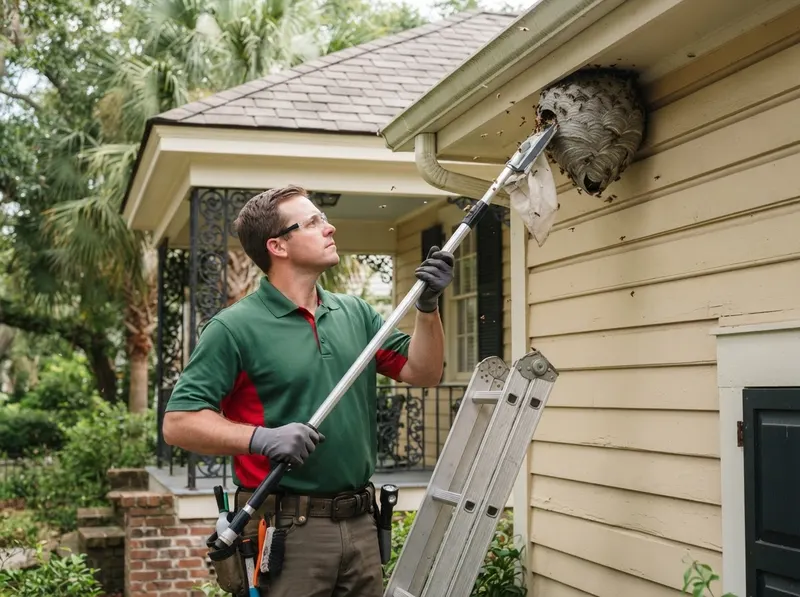
Discovering an active stinging insect colony near entry doors, piazza ceilings, or rooflines presents immediate health risks and structural liabilities. High humidity and extended maritime warm seasons accelerate the growth of aggressive colonial hymenoptera throughout the Lowcountry. In historic areas like South of Broad, Harleston Village, and Radcliffeborough, European paper wasps and yellowjackets regularly exploit aged heart-pine soffits, lath-and-plaster wall cavities, and ornamental brick crevices. WillowCrest Pest Management executes targeted nest extractions utilizing calibrated aerosolized botanical pyrethrins and mechanical vacuums approved under EPA pesticide safety standards. Field technicians wear complete positive-pressure protective suits, neutralizing aerial nests before physically detaching the comb structure to prevent larval decay and subsequent scavenger infestations.
Different species demand distinct tactical responses. Aerial bald-faced hornets construct expansive fibrous paper enclosures up to 24 inches in diameter within live oak canopies near Hampton Park and Wagener Terrace, requiring high-pressure micro-encapsulated knockdowns to prevent defensive swarm dispersion. Conversely, southern yellowjackets frequently build subterranean colonies within sandy loam soils across James Island and West Ashley, often revealed during residential turf mowing near tidal ditches. Subterranean removals require localized non-repellent liquid injections beneath the surface to neutralize deep brood chambers, followed by complete physical excavation. Guidance from the Clemson Cooperative Extension Home & Garden Information Center emphasizes that surface-only retail sprays fail to penetrate subterranean brood clusters, often redirecting agitated wasps toward indoor spaces.
Stinging insect nest removal cost variables reflect accessibility, colony volume, and structural complexity. Standard accessible exterior treatments range from $300 to $450, while complicated extractions within crawlspaces, chimney flues, or deep attic bays across Daniel Island and the Cainhoy Peninsula range from $500 to $950. Removing the physical comb is mandatory; leaving unhatched brood combs inside an attic void attracts carpet beetles, secondary nuisance flies, and structural mold. Once technicians finish extraction, entry voids receive physical seals using stainless steel mesh and silicone sealants compliant with IPM Institute of North America building exclusion standards.
Technicians operate under strict professional safety mandates established by the Occupational Safety and Health Administration to protect residents and domestic pets during active treatment. When honey bee colonies are confirmed in historic framing or trees near landmarks like the Arthur Ravenel Jr. Bridge or Charles Towne Landing State Historic Site, we prioritize non-lethal extraction. Live removals coordinate alongside local apiarists recognized by the South Carolina State Beekeepers Association to preserve crucial pollinators in accordance with Clemson University Department of Pesticide Regulation guidelines. For non-bee pests, our applications integrate marshland-safe targeted protocols aligned with the National Wetlands Inventory, protecting delicate coastal water tables while restoring perimeter security. Homeowners receive transparent, single-incident resolutions without mandatory multi-year billing commitments.
Every job gets a firm, written price after a free on-site visit.
Tell us about your stinging insect nest removal job in Charleston and we'll send a clear, written quote, usually the same day.
 WillowCrest Pest Management