WillowCrest Pest ManagementWillowCrest Pest Management

Flea and Tick Yard Treatment Charleston

Outdoor tick and flea management throughout coastal South Carolina requires understanding microhabitats created by sustained humidity, dense maritime canopy, and high water tables. Sub-canopy zones in Wagener Terrace…
Get My Free Estimate →(843) 268-6994
Flea and Tick Yard Treatment in Charleston, SC
Quick answer
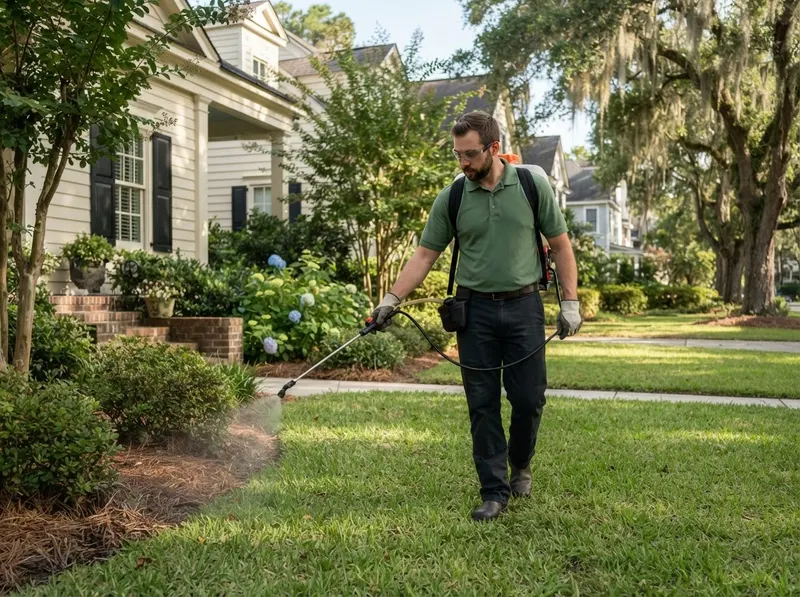
  • Application includes liquid microencapsulated adulticides paired with an insect growth regulator (IGR) applied up to 3 feet high on foundation walls, shrub understories, and shaded fence lines.
  • On-site diagnostic assessments and perimeter applications deploy within 24 to 48 hours of intake across Charleston County properties.
  • Service ballparks start at the $300 minimum baseline for single-family coastal lots up to 0.25 acres, with exact totals confirmed on-site.
  • Targeted outdoor pests include the blacklegged deer tick (Ixodes scapularis), brown dog tick (Rhipicephalus sanguineus), American dog tick (Dermacentor variabilis), and cat flea (Ctenocephalides felis).
  • Scheduling requires calling (843) 268-6994 to arrange an inspection, with standalone visits available without multi-year billing contracts.

Outdoor tick and flea management throughout coastal South Carolina requires understanding microhabitats created by sustained humidity, dense maritime canopy, and high water tables. Sub-canopy zones in Wagener Terrace along the Ashley River and historic walled courtyards in Harleston Village and South of Broad retain significant soil moisture beneath live oak canopies. These shaded leaf-mold layers provide optimal incubation conditions for the cat flea (Ctenocephalides felis biology) and questing stations for the blacklegged tick (Ixodes scapularis vector profiles). Conventional retail granular applications rarely penetrate deep maritime thatch. Targeted spray liquid barriers wet the organic detritus layer directly, delivering contact mortality while binding an insect growth regulator like pyriproxyfen (NPIC insect growth regulator science) to prevent immature flea larvae and pupae from molting into biting adults.

Marsh-adjacent properties on James Island, Daniel Island, and the Cainhoy Peninsula face continuous cross-property wildlife pressure from white-tailed deer, marsh rabbits, and raccoons depositing ectoparasites across natural property borders. Property owners must differentiate whole-yard broadcast sprays from focused eco-conscious perimeter defense. Indiscriminate broadcast blanket sprays across open, direct-sun Bermuda lawns waste chemistry because ultraviolet radiation degrades active ingredients rapidly, and direct sun keeps surface humidity too low for flea larvae survival (EPA flea and tick habitat management). Instead, structural barrier treatments target cool transitional zones: 3 to 6 feet deep along perimeter marsh fences, wood lines, shaded shrub beds, crawl space vents, and moisture-retaining mulch beds. Applying microencapsulated pyrethroids alongside juvenile hormone mimics binds to leaf surfaces without running into brackish tidal basins, matching integrated guidelines established by the Clemson University Extension Service.

Homeowners choose between singular targeted interventions and multi-month seasonal regimens between March and November, when Charleston County average temperatures remain above the 65°F reproductive threshold. For residential estates in Radcliffeborough or newer sub-developments in West Ashley, a single high-impact treatment extinguishes an existing seasonal boom, whereas properties bordering undeveloped woods or palmetto scrub benefit from re-application intervals of 30 to 60 days. The operational trade-off centers on landscape density versus chemical persistence: heavy daily landscape irrigation systems wash through chemical barriers faster than natural rainfall, requiring precision wand placement directly under heavy plantings rather than overhead broadcast dispersion. All outdoor treatments require pets and children to remain indoors until liquid applications dry fully, which averages 60 to 90 minutes in coastal air, ensuring compliance with Clemson Department of Pesticide Regulation guidelines.

How much does Flea and Tick Yard Treatment cost in Charleston?

Urban Courtyard or Townhome Lot (<0.10 Acre, e.g., South of Broad)$300, $375
Standard Residential Yard (0.15 to 0.25 Acre, e.g., West Ashley, James Island)$350, $475
Mid-Sized Half-Acre Lot (0.25 to 0.50 Acre, e.g., Daniel Island, Wagener Terrace)$475, $650
Expanded Coastal Estate or Marsh Acreage (0.50+ Acre, e.g., Cainhoy Peninsula)$650, $950+

Every job gets a firm, written price after a free on-site visit.

Common questions

How much does professional flea and tick yard treatment cost in Charleston?
Professional flea and tick yard treatment in Charleston carries a $300 minimum charge for lots up to 0.25 acres, with larger residential acreage ranging between $350 and $650 based on landscape square footage, moisture density, and fence perimeter length. Exact totals are confirmed during an initial on-site physical evaluation.
How quickly can pets safely return to the yard after an exterior treatment in Charleston?
Pets can safely return to the yard once the liquid spray dries completely, which typically takes 60 to 90 minutes under average Charleston humidity and ambient coastal warmth. Homeowners should verify that turf, pine straw, and shaded foundation plantings are fully dry before letting animals re-enter the treated perimeter.
Why are fleas and ticks so aggressive in Charleston yards compared to inland regions?
Fleas and ticks thrive in Charleston because maritime humidity, mild winter low temperatures, and extensive maritime forest canopies prevent hard annual ground freezes that naturally suppress tick nymphs. High populations of urban wildlife, such as opossums and coastal deer moving through tidal corridors, continually reintroduce parasites onto residential turf.
Does outdoor yard treatment eliminate the need for indoor flea control in Charleston homes?
Outdoor yard treatment neutralizes external breeding reserves, but it does not remove fleas already breeding inside carpets, floorboards, or pet bedding. Comprehensive eradication requires treating infested indoor structural zones concurrently while maintaining active veterinary-approved preventative treatments on domestic animals (AVMA veterinary ectoparasite prevention).
Are flea and tick yard treatments safe for tidal creeks and marsh borders in Charleston County?
Flea and tick yard treatments maintain environmental safety near tidal borders by establishing strict 10- to 25-foot untreated buffer zones adjacent to salt marshes, pluff mud banks, and retention ponds, adhering to South Carolina DHEC coastal runoff protocols. Technicians use coarse-droplet targeted wand applications instead of mist blowers to eliminate spray drift toward sensitive aquatic life (NOAA coastal wetland standards).

Get started today

Tell us about your flea and tick yard treatment job in Charleston and we'll send a clear, written quote, usually the same day.

Get your free Pest Control Service quote, Charleston

We only use your ZIP to check availability, no spam.